|
|
| |
|
|
|
| Lectures & Events
Landcraft will be participating in The Garden Conservancy Open Days Program on July 10, 2010. Please click on The Garden Conservancy website for more information.
All other groups, please call to schedule a date and time for a garden tour.
The Herb Society of America, Long Island Unit
19th Annual Herb Symposium
April 8, 2010
Ellen Zachos and others, including Dennis Schrader, will speak on Thursday April 8th 9:00am-2:30pm. Luncheon to feature herbal dessert and raffle. Tickets $48. For more information, call Dava Stravinsky at 631-286-3760
Location:
Old Field Club
86 West Meadow Road
Setauket, NY 11733
Email: stravins@optonline.net
Long House Reserve
Planter Exhibit June 26, 2010 (on display until October 9th)
Longhouse Reserve
Location:
133 Hands Creek Road
East Hampton, NY 11937
Northeast Greenhouse Conference
November 3-4 2010
The Northeast Greenhouse Conference and Expo is the northeast's premier horticultural trade show. Dennis Schrader will be lecturing about Tropical plant material at the event.
Location:
DCU Center
Worcester, MA
|
| Television
Landcraft custom grows many plants for a variety of television shows in an effort to help broaden the horticultural pallet of gardeners everywhere. Dennis and Bill have appeared in national and international television programs such as Martha Stewart Living TV and Gardeners World where they have led guided tours through their 2 _ acre garden. Dennis has worked on TV productions for The Today Show, Better Homes & Gardens TV, HGTV and has been a regular guest on Martha Stewart Living TV where he has demonstrated "how to" projects
ranging from making topiaries, planter combinations, and propagating plant material
to plant profiles such as fragrant house plants, passion flowers and tropical plants.


|
Carnivorous Plants with Dennis Schrader
Play Video

|


|
| Books
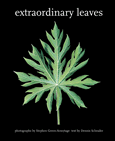
Dennis and Stephens NEW book Extraordinary Leaves is a celebration of one of nature's miracles.
As Dennis explains: "To prepare this book, I have been obligated to take a more intimate look at all aspect of leaves -their many uses, their place in history, the science behind what's going on in a leaf and the unadulterated, simple beauty of the leaf itself."
Extraordinary Leaves is available in quantity directly from Landcraft and Firefly Books, or purchased individually from Amazon.com. We will also have a supply here at a discounted rate for individual sales.

Buy Now
|
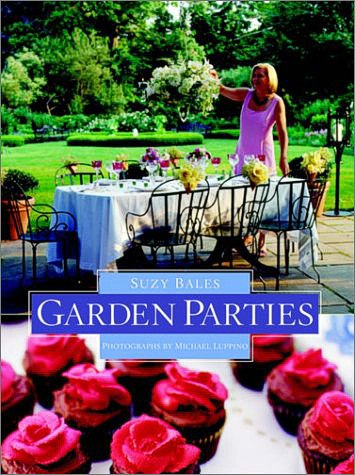
The gardens at Landcraft will be featured in the following books:

|
Magazines
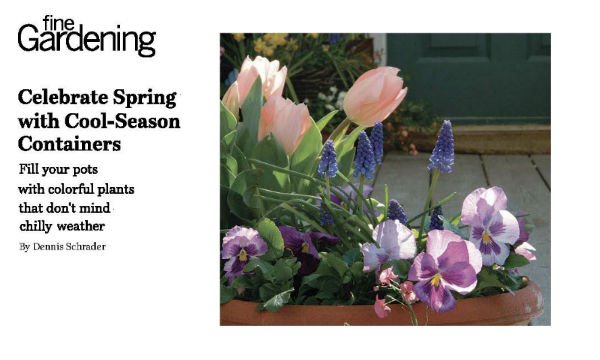
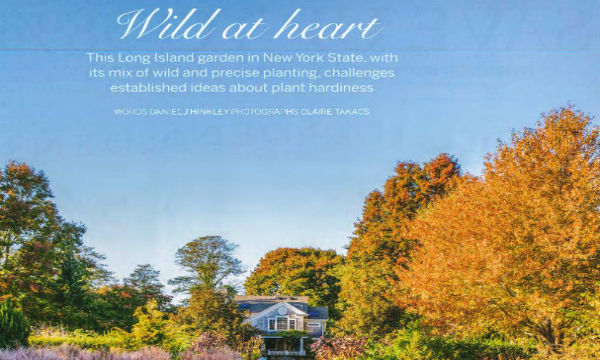
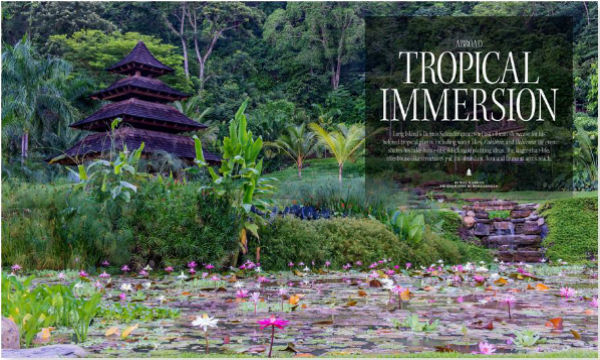
The gardens at Landcraft have been
featured in the following publications; Fine Gardening, and Traditional Home. |
Beyond the Comfort Zone
See the full slideshow
Plant collecting has taken front row center in the Dennis Shrader/Bill Smith household on Long Island. The steps from the deck are an extension of the garden, where containers of various sizes and materials are used to good effect. Some hold individual specimens of plants that being nursed along for possible propagation, while others hold mini-landscapes of varieties seen throughout the garden. When growing a container garden, be sure to feed regularly as watering quickly leaches nutrients from the soil.
The old design principle of keeping formal elements of the garden close to the house while the more natural and informal planting schemes are furthest away is one that works in any garden, no matter how big or small. The clipped knot garden at the entrance to Dennis and Bill's home is typical of the sort of formal feature that can be used to achieve an orderly yet picturesque effect. Design your own knot pattern based on a motif in a carpet or other décor feature.
The so-called tiki hut is an open-sided garden building at the heart of the garden; its walls are made from the dense planting surrounding it. Outdoor spaces like this are like secret gardens within the garden, offering a quiet refuge. Find a quiet corner in your own garden and with tall-growing plants and evergreen shrubs surrounding a small carpet of close-clipped grass, carve out a tiki-like island of calm. Furnish it with a comfortable deckchair and a few scattered cushions and take a 20-minute vacation!
A wet, marshy area surrounding the pool near the garden's edge has been planted with a variety of native and ornamental grasses, including the reed Juncus stygius ssp. Americanus, Pennisetum villousum 'Feathertop' and low-growing Festuca ovina. A simple dogleg plank bridge gives focus to informal scene, as well as keeping feet dry. Adding a variety of small habitats like this to a garden will attract an assortment of wildlife, adding another layer of interest—and beauty—to the garden.
Weeds are plants in the wrong place, it's said. But beauty is in the eye of the beholder, and if you're nuts about plants, a double-flowered rose plantain (Plantago major 'Rosularis') is a lovely thing. With its bottlebrush shaped blossom, it is a decorative version of the common—and reviled—lawn weed. There is also a purple-leaved version of the weed that is good foliage plant for groundcover, though seedlings of R.m. 'Atropurpurea', can become invasive.
Water features are an integral part of this garden, and here the watery course of the rill pool unites two garden rooms that sit opposite each other along a main axial pathway. Each end of the rill is enlarged to form the small pools that serve as reservoirs for the recycling pump that keeps the water circulating along the length of the rill.
Alocasia amazonica, popularly known as the African Mask is a tropical plant admired for the bold white veins etched across the dark green leaves. It is not at all hardy and the tubers from it grows can be preserved over winter if kept in a dry compost in a cool, dark place. As the spring advances, bring the pot into light and begin watering to kick-start the plant's growth cycle. When the soil begins to warm and there is no further danger of a cold snap and frost, it can be planted out in the border or as the central feature in a container.
One of the tricks of plant combining is to match leaf shape, but contrast scale. Here the giant taro leaf dwarfs the heart-shaped leaves of an annual verbena. Look for similar contrasts of scale among other bedding plants when composing a summer display—tropical plants provide some of the most dramatic counterpoints in size, shape and color, too.
The leaves of Cristia, a distinctive tropical plant, are shaped rather like a swallowtail butterfly, hence its common names, swallowtail or butterfly plant. Christia obcordata is typically found in southeast Asia, but has spread to south America. And now, thanks to nurserymen like Dennis and Bill, is appearing in gardens and specialist nurseries in the USA.
On the principle that "too much is never enough," a regiment of urns planted with Agave desmettiana, gray-leaved Lampranthus deltoides, and chartreuse green Sedum repestre 'Angelina' lines a gravel path against a hedge of American hornbeam.

|
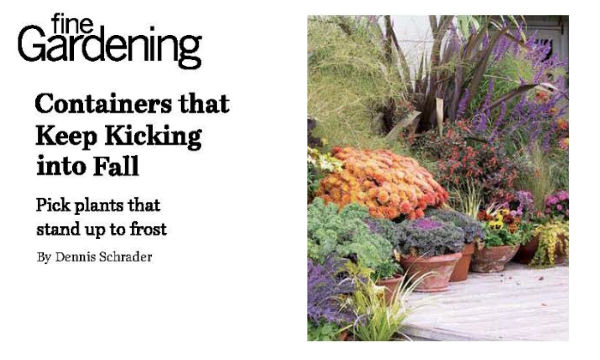
Fine Gardening Containers that Keep Kicking into Fall
Pick plants that stand up to frost
By Dennis Schrader
The transition from the exuberance of summer, when my containers are looking their fullest and most luxuriant, to the first frost, when the more tender plants collapse, used to be a terribly upsetting time for me. But over the last few years, Ive learned that the onset of autumn doesnt have to mean the end of the container gardening season. There are plants available from garden centers that are geared fro fall, and I collect a few more from my garden to create a display that carries my containers through until its time to put out the Christmas greens.
A trip to the garden center in September or October seems at first glance to yield just the same old mums, kales, and pansies. But if you look more closely you can usually find additional choices for your fall pots. Many of the plants in my fall container garden are from Proven Winners Fall Magic Collection, plants marketed specifically for fall and labeled to make it easy to mix and match them. Although I still rely on pansies, grasses, kale and garden mums to dress up my containers, I also use other plants that look good into fall, including coralbells (Heuchera spp. and cvs. ), cyclamens (Cyclamen spp and cvs), osteospermums (Osterspermum spp. and cvs.), euphorbia (Euphorbia spp and cvs.), nemesias (Nemesia spp. and cvs), deadnettles (Lamium spp. And cvs.), and snapdragons (Antirrhimium spp. and cvs).
Another less expensive and more readily available source for plant material is my own garden. Taking a division from a clump of coralbells, a sedge (Carex spp and cvs), an ornamental grass or a sedum (Sedum spp and cvs) and potting it up in summer for use in my fall containers saves
quite a bit of money. Occasionally, Ill even use a plant that was part of a summer container that can withstand a frost or two, like corn stalks, branches, and even gourds or pumpkins from the fall harvest can be used to round out the picture.
Use small pots to accent large combination planters
I use so many types of plants in so many pots that Ive had to come up with a design strategy that works. My biggest concern is providing continuity to the design, and I do this typically by potting up a few large combination planters with an assortment of plants. Then I repeat the colors and textures Ive used in the mixed planters in smaller pots with single plants and arrange them in pleasing combinations. In general, I use crisp autumnal shades to reflect the colors of the surrounding landscape.
In last years garden the dominant colors were purple, burgundy, orange and yellow. The velvety purple fo the flower spikes of the late-blooming Mexican bush sage (Salvia leucantha) was carried through the design with three types of purple-leaved ornamental kale, and the garden mum Valerie (Chrysanthemum Valerie). Bronze and burgundy were represented by a tall-growing mahogany-colored flax (Phormium tenax Atropurpureum) , pansies (Viola X wittrockiana Antique Shades), various garden mums, coralbells, leather leaf sedge (Carex buchanii), purple wood spurge (Euphorbia amygdaloides Purpurea), and the bronzed foliage of the firecracker plant (Cuphea ignea David Verity)
To represent the brighter colors of fall, I incorporated the bright-orange tubular blooms of the firecracker plant, more mums and pansies, and added a salmon-color osteospermum (Osteospermum Orange Symphony). Two other osteospermums (O. Lemon Symphony and O. Cream Symphony) mimic the yellow elf color of the surrounding trees and are both great fall performers, able to withstand a few frosts. More yellow and gold color comes from pansies (Viola X wittrockiana Delta Fire, Bingo Yellow, Blotch and Crystal Bowl Yellow), mums, late-season dahlias (Dahlia spp and cvs and the sunny yellow Marguerite daisy (Argyranthemum Frutescens Butterfly) . The golden foliage of creeping
Jenny (Lysimachia nummularia Aurea) and a chartreuse-variegated acrous grass (Acorus gramiueus Ogon) round out the warm fall colors with their foliage.
Once I get the containers in place, I water them in using a balanced water soluble fertilizer. Because the weather is cooler, the pots dont need to be watered as often as summer pots do, so I get to spend more time sitting back and enjoying the bounty that fall has to offer. And come December,
if the snow and ice hold off long enough, the ornamental kale, dried grasses, and seed heads of some of the perennials from my fall containers might even make it into a few of my winter displays. |
AUDIO SLIDESHOW:
One Garden, Many Styles
by Dennis Schrader
- Landscape designer
Dennis Schrader is a master when it comes to unlikely combinations. He and his partner, Bill Smith, own and operate Landcraft Environments, a wholesale greenhouse in Mattituck, New York, which specializes in exotic annuals and unusual tropical plants. Dennis is coauthor of Hot Plants for Cool Climates, and his unique design style has been featured extensively in Fine Gardening magazine over the years. Recently, Dennis sat down to explain how he achieves such stunning plant combinations and to share some secrets to creating an amazing landscape.

|

|
Horticulture
Tender Blades
These fast-growing frost-sensitive grasses offer northern gardeners a host of unusual colors and shapes
By Dennis Schrader
Photos by Susan A. Roth
Incorporating ornamental grasses into garden beds, perennials borders, and mixed planning has become increasingly popular during the last decade. Grasses once found only in wild meadows and fields or underfoot in sheared suburban lawns have come inter their own as substantial elements of garden design.
In every season, grasses provide movement, structure, and excitement in the garden. Their fresh new growth heralds the arrival of spring, and as the days warm and summer arrives, they become the stars of the garden by flaunting showy flower heads and handsome foliage. At the onset of cooler weather, grasses continue to provide interest as their autumnal colors and seed heads appear. In the winter, grasses maintain their structure in the garden as well as their soft tan, bronze or beige colors.
There are about 635 genera and over 9,000 species of grasses. The numbers go even higher when you add all the cultivars and hybrids. A large percentage of the members of the Poeceae (formerly the Gramineae), as the grass family is called, are found only in tropical and subtropical regions.
Just as hardy perennial grasses have become more popular, tender grasses (those that will not survive freezing temperatures) are also increasing in popularity. A word of caution about using tender grasses in mild zones (USDA Zones 8-11): Many of them reseed and can become invasive, so check with your local extension agency before incorporating them into your garden. Shape and Movement
Tender grasses can also be appreciated for their shapes and for the sense of movement they bring to the landscape. Muhly grass (Muhlenbergia dumosa; Zone 8) is one of the softest and most delicate-looking grasses of all the tender grasses. It grows to a height of four feet, and its slender, arching stems are covered with feathery leaves; the slightest breeze makes this grass glitter and sway. When planted in grouping in a perennial or mixed-shrub border, its wispy, delicate foliage contrasts nicely against bolder, more statuesque plants. You can also incorporate it into a container of plants with strong broad leaves, such as alocasia, colocasia or cannas.
Ruby grass (Thynchelytrum repens) is a short-lived perennial in warm climates (Zone 8) and is treated as an annual in northern regions. A native of open, some what dry regions in Africa, ruby grass will grow to a height of two to three feet, and the gray-green, four-inch leaves are borne along graceful stems. The flowers first appear in terminal panicles that are a shimmering pinkish red. As the four to six in flower heads mature and open, they turn first to pale pink and then to a silvery white. The last stage of the flowering cycle may be what gives R. repens the common name "champagne grass"; its translucent silver seeds shimmer like bubbles in a champagne flute. Plant it in large drifts along with Verbena vonariensis and Nicotiana langsdorffii. Its free-spirited good looks are reminiscent of wild meadows and open fields. The flowers are produced all summer, until a hard frost.
|
|